


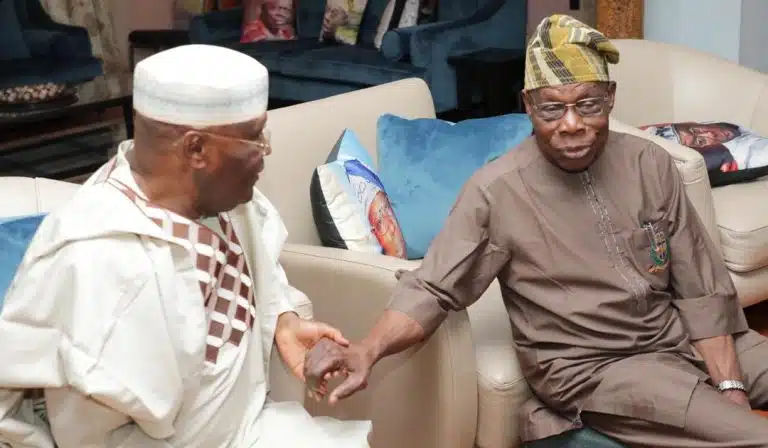
Former Vice-President Atiku Abubakar has rejected former President Olusegun Obasanjo’s latest criticism of him, describing it as another attempt to rewrite the history of their political relationship.
Atiku said he stood by Obasanjo while the former military ruler was in prison, supported him after his release and played a major role in his emergence as President in 1999.
He also defended his opposition to the alleged third-term agenda during the Obasanjo administration, saying he had no regrets for choosing constitutional democracy over personal loyalty.
Atiku made the remarks in a statement issued on Saturday by his Senior Special Assistant on Public Communication, Phrank Shaibu.
Obasanjo had on Friday described his decision to select Atiku as his running mate in the 1999 presidential election as the greatest mistake of his presidency.
The former president made the comment in Lagos during a fireside conversation with veteran entertainer and activist Charles Oputa, popularly known as Charly Boy.
The event was held to mark the public presentation of Charly Boy’s foundation and memoir, 999: A Memoir in Tribute to Late Justice Chukwudifu Oputa.
Responding, Atiku described Obasanjo’s comments as “another failed attempt to rewrite history.”
The former vice-president said his opposition to the controversial third-term bid was based on his commitment to Nigeria’s Constitution.
“I am proud that I stood against the third-term agenda. I am proud that I stood by the Constitution of the Federal Republic of Nigeria. I have no apology whatsoever for frustrating every attempt to subvert our democracy for personal ambition,” he said.
Atiku added that if Obasanjo remained bitter over his refusal to support the plan, he would regard the former president’s resentment as a badge of honour.
“If Chief Obasanjo’s bitterness stems from my refusal to support an unconstitutional third term, then I wear that resentment as a badge of honour,” he said.
“No individual, regardless of his status or accomplishments, is bigger than the Federal Republic of Nigeria. The Constitution is supreme, and I chose Nigeria over personal loyalty.”
Atiku maintained that the dispute was not merely personal but concerned the survival of constitutional democracy.
“The Nigerian people won that battle. Democracy won that battle. History has already delivered its verdict,” he added.
Atiku also recalled his support for Obasanjo during and after his incarceration under the military regime.
He said, “History records that while Chief Obasanjo was in prison, I stood firmly by him. I supported his family, worked tirelessly with other patriots for his release and never wavered in my belief that he deserved his freedom.”
According to the former vice-president, Obasanjo had little when he regained his freedom, prompting him to provide personal and political support.
“When he eventually regained his freedom, he had little to his name. I received him, clothed him, ensured he was properly cared for and extended every support necessary to help him regain his footing,” Atiku said.
He also claimed to have mobilised political structures and built alliances that contributed to Obasanjo’s presidential victory.
“Beyond that, I mobilised political structures, built alliances and made enormous personal and political sacrifices that culminated in his emergence as President of the Federal Republic of Nigeria,” he stated.
Despite the deterioration of their relationship, Atiku said he did not regret assisting Obasanjo.
“Do I regret helping Chief Obasanjo? Absolutely not. When God gives you the opportunity to lift another human being, you do so without expecting repayment,” he said.
“Acts of kindness are matters of conscience, not commercial transactions.”
He, however, argued that gratitude should not be replaced by what he described as revisionism.
The former vice-president also referred to recent comments attributed to the Director-General of the World Trade Organisation, Dr Ngozi Okonjo-Iweala, who reportedly praised the economic management team led by Atiku during the Obasanjo administration.
Atiku said the remarks showed that senior figures who served in the government continued to recognise his contributions.
“Whether or not the timing is merely coincidental is for Nigerians to judge,” he said.
“What is beyond dispute, however, is that while distinguished Nigerians who served at the highest levels continue to acknowledge my contributions to one of Nigeria’s most successful periods of economic management, Chief Obasanjo appears determined to diminish them.”
Atiku criticised Obasanjo for revisiting their political disagreement at a time when Nigeria was facing insecurity, unemployment and economic hardship.
“The 2027 election should be about rebuilding Nigeria, restoring security, reviving the economy and giving hope to the next generation—not reopening old political wounds,” he said.
He added that although he had exercised restraint out of respect for Obasanjo and the office he once occupied, he would not continue to ignore what he considered distortions of history.
“There comes a point when silence in the face of repeated distortions of history ceases to be a virtue,” Atiku said.
“Chief Obasanjo is entitled to his opinions. He is entitled to his personal grievances. What he is not entitled to are his own facts.”
The former vice-president said his attention remained focused on Nigeria’s future rather than personal disputes.
“History is stubborn. It cannot be rewritten by bitterness, nor erased by repeated falsehoods,” he added.
“In the end, history will render its verdict—and so will the Nigerian people.”
