


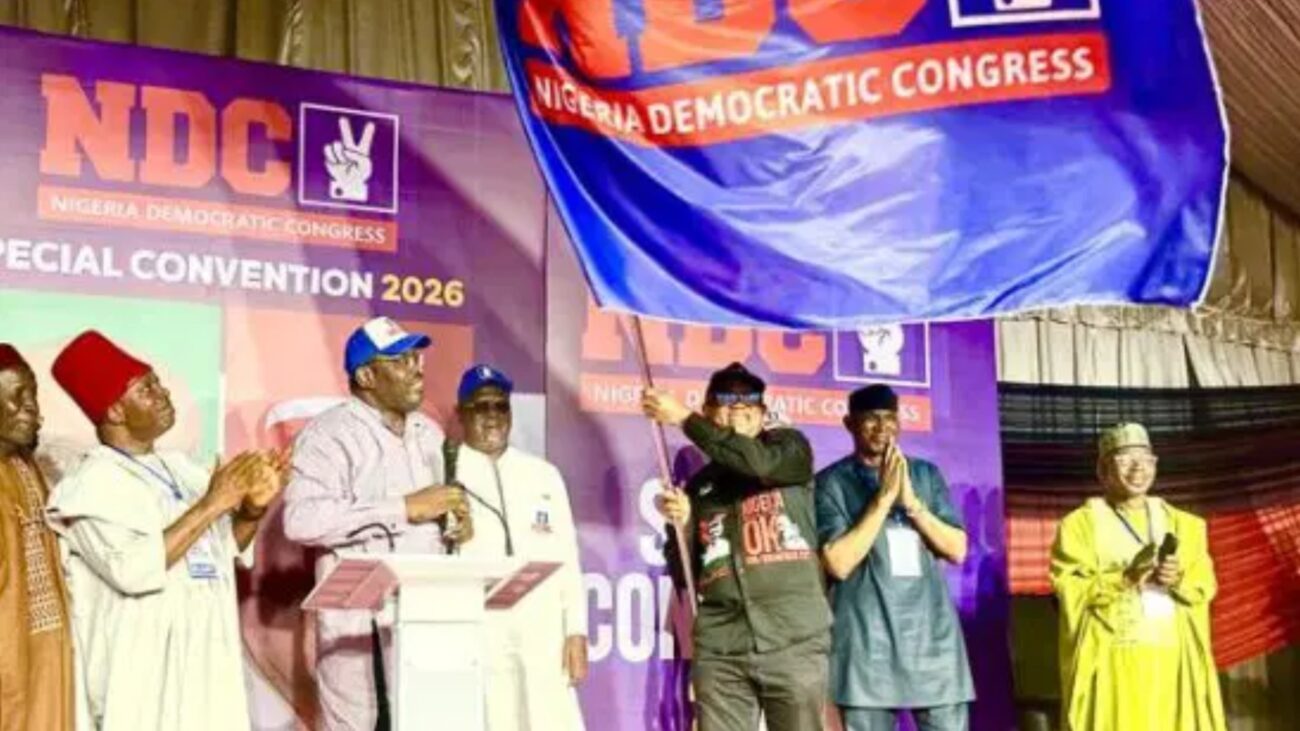
The Certified True Copy of the Federal High Court judgment on the deregistration of the Nigeria Democratic Congress (NDC) has emerged.
Naija News reports that the ruling, delivered by Justice Isa H. Dashen at the Lokoja Judicial Division last Friday, effectively sets aside a December 10, 2025, judgment that had previously compelled the Independent National Electoral Commission (INEC) to register the party.
According to the court ruling, the prior judgment was nullified because it affected the legal rights of the Peace Movement Party (PMP, which claimed ownership of the logo used by the NDC but was never joined as a party to the original lawsuit.
The Certified true copy of the judgment read, “This is a ruling on a Motion on Notice dated 4th May, 2026 and filed on 5th May, 2026 by the Applicant/Affected Party, Barrister Emmanuel Uzowuru, the Protem National Legal Adviser of the Peace Movement Party (PMP), for himself and as representative of the Peace Movement Party (PMP).
The application is brought pursuant to Order 26 Rules 1 and 8, and Order 56 of the Federal High Court (Civil Procedure) Rules, 2019, and under the inherent jurisdiction of this Honourable Court.
Reliefs Sought
By the said Motion, the Affected Party/Applicant seeks the following reliefs:
An Order of this Honourable Court extending the time within which the Affected Party/Applicant may apply to set aside the judgment of this Court delivered on the 10th day of December, 2025, in Suit No. FHC/LKI/CS/49/2025 between Barr. Takori Mohammed Sani (Protem National Secretary, NDC) & 3 Ors. v. Independent National Electoral Commission (INEC).
An Order of this Honourable Court setting aside the judgment of this Court delivered on the 10th day of December, 2025, in Suit No. FHC/LKI/CS/49/2025 between Barr. Takori Mohammed Sani (Protem National Secretary, NDC) & 3 Ors. v. Independent National Electoral Commission (INEC).
“The grounds upon which this application is brought are set out on the face of the Motion. The Motion is supported by a 41-paragraph affidavit deposed to by Emmanuel Uzowuru, Esq., the Protem National Legal Adviser of the Affected Party/Applicant, together with Exhibits A, B, C, D, E, F and G respectively.in support of the application, a Written Address was also filed by the Affected Party/Applicant, wherein learned counsel canvassed arguments in support of the application.
“Response by the Plaintiffs/Respondents
In opposition, the Plaintiffs/Respondents filed a 54-paragraph Counter-Affidavit to the Affected Party/Applicant’s Motion on Notice. The Counter-Affidavit was sworn to by Kareem Henry and was accompanied by exhibits marked NDC “A” to NDC “S”.
Suit No.: FHC/LKI/CS/49/2025
Barr. Takori Mohammed Sani & 3 Ors. Plaintiffs/Respondents
v.
Independent National Electoral Commission (INEC) Defendant/Respondent
and
Barr. Emmanuel Uzowuru (Affected Party/Applicant)
RULING (Continued)
The Counter-Affidavit was accompanied by Exhibits NDC “B”, NDC “C” and NDC “D”, together with a Written Address in support thereof, wherein the Plaintiffs/Respondents urged the Court to dismiss the application.
The Plaintiffs/Respondents also filed a 29-paragraph Reply Affidavit in opposition to the Defendant/Respondent’s Affidavit of Facts filed on 26th May, 2026, together with Exhibits NDC 1, NDC 2 and NDC 3, and a Written Address.
The Plaintiffs/Respondents further filed an 11-paragraph Further Counter-Affidavit in opposition to the Defendant’s Affidavit of Facts filed on 4th May, 2026.
“On the part of the Defendant/Respondent, a 22-paragraph Affidavit of Facts in response to the Affected Party/Applicant’s Motion on Notice was sworn to by Yabagi Ibrahim Bashiru on 26th May, 2026. The deponent, a Higher Executive Officer at the Headquarters of the Defendant/Respondent, filed the affidavit without a Written Address in support.
The foregoing represents the various processes filed by the parties for the determination of this Motion on Notice.
Hearing of the Motion On 26th June, 2026, when the matter came up for hearing, C.S. Ekeocha, Esq., learned counsel for the Affected Party/Applicant, appeared and adopted the processes filed on behalf of the Applicant.
For the Plaintiffs/Respondents, Reuben Egwuaba, Esq., with H.O. Yusuf, Esq., adopted their processes, adumbrated on same, and urged the Court to resolve the issues raised in the application in favour of the Plaintiffs/Respondents.
Similarly, F.A. Kotso, Esq., learned counsel for the Defendant/Respondent, adopted the Defendant’s processes and urged the Court to determine the application in favour of the Defendant/Respondent.
The respective counsel accordingly urged the Court to resolve the dispute arising from the application in favour of the parties they represent.
BACKGROUND FACTS:
“The present proceedings arose from an application filed by the Party Affected/Applicant, Peace Movement Party (PMP), seeking, amongst other reliefs, an order setting aside the judgment delivered by this Court on 10th December 2025 in Suit No. FHC/LKI/CS/49/2025 between Barr. Takori Mohammed Sani & 3 Ors. (for themselves and on behaif of the Nigeria Democratic Congress (NDC)) and the Independent Nationa! Electoral Commission (INEC).
“The record of this Court reveals that the substantive suit was commenced by way of Originating Summons wherein the Plaintiffs chatlenged the decision of the Independent National Electoral Commission (INEC) refusing to register the Nigeria Democratic Congress (NDC) as a political party. The Plaintiffs contended that they had fulfilled all constitutional and statutory requirements prescribed under Section 222 of the Constitution of the Federal Republic of Nigerta, 1999 (as amended) and the Electoral Act, 2022, and that INEC acted unlawfully in discontinuing the registration process.
“The Defendant, INEC, opposed the suit and justified its decision on grounds which included issues relating to the proposed logo and symbol submitted by the Plaintiffs as part of their registration documents. Upon a consideration of the affidavit evidence and submissions of counsel, this Court delivered judgment on 10th Subsequent to the delivery and implementation of the said judgment, the present Applicant, Peace Movement Party (PMP), who was not a party to the substantive proceedings, approached the Court complaining that the judgment was obtained without disclosure of material facts touching directly on its own application for registration as a political party and its prior interest in the disputed two-finger victory logo.
“The Applicant’s case is that long before the institution of the substantive suit, it had commenced the process of registration as a political party and had submitted the same two-finger victory logo to INEC as part of its registration documents. The Applicant contends that this fact was known to INEC and that the logo in question had already become associated with its registration process before NDC presented the same logo for registration.
“According to the Applicant, the Court was never informed during the hearing of the substantive suit that another political association had previously submitted the same logo and that a competing claim to the symbol already existed. The Applicant maintains that had these facts been disclosed to the Court, the Court would have had the benefit of considering the effect of such prior claim and the consequential Impact of any order touching upon the registration of NDC with the disputed togo.
The Applicant therefore alleges that the judgment was entered upon incomplete and materially deficient facts and that its proprietary and registration interests were directly affected by orders made in procecdings to which it was neither joined nor afforded an opportunity of being heard. It is on this basis that the Applicant invokes the inherent jurisdiction of the Court to revisit and set aside the judgment in the interest of justice.
“In response, the Plaintiffs/Respondents contend that the substantive Suit was concerned solely with the legality of INEC’s refusal to register NOC and not with the determination of ownership of any logo or symbol. The Plaintiffs/Respondents deny suppressing any material fact and maintain that the Applicant was not a necessary party to the proceedings. They further contend that the judgment was validly entered and that the Applicant has failed to establish any legally recognised ground upon which a final judgment of a competent Court may be set aside.
“The Defendant/Respondent, INEC, also filed processes in response to the application. Significantly, portions of the Defendant/Respondent’s affidavit evidence acknowledge that both the Applicant and NDC submitted the disputed two-finger victory logo and further disctose that the Applicant had submitted the logo before NDC. The parties thereafter exchanged affidavits and written addresses and urged the Court to resolve the application in their respective favour.
“It is against this factual background that the Court ts called upon to determine whether the circumstances disclosed by the affidavit evidence, particularly the alleged non-disclosure of the Applicant’s Prior interest in the disputed logo and registration process, constitute.
This finding is crucial.
“The substantive suit which culminated in the judgment of 10th December 2025 was instituted to challenge the legality of the Defendant’s refusal to register the Nigeria Democratic Congress (NDC) as a political party. The Defendant’s justification for that refusal necessarily formed part of the factual matrix upon which the Court was invited to adjudicate.
“Where a material fact constituting part of the factual basis of the impugned administrative decision concerns the pre-existing and competing interest of an identifiable third party, the Court cannot properly and effectually determine the dispute without hearing such party.
“The contention of the Plaintiffs/Respondents that the substantive suit did not involve ownership of the disputed logo and therefore did not require the participation of the Applicant is, with profound respect, misconceived.
“The issue is not whether the Court was called upon to determine proprietary ownership of the logo. The issue is whether the Court was invited to make orders whose direct legal consequence would affect the competing and pre-existing interest of a person who was not before the Court.
“In my respectful view, once the affidavit evidence disclosed that the Applicant had previously submitted the disputed logo and that such. The Plaintiffs/Respondents have contended that the present application constitutes an invitation to this Court to sit on appeal over its own judgment. I am unable to agree.
” It is beyond dispute that, upon the delivery of a final judgment, a Court becomes functus officio and lacks jurisdiction to review, vary, or reconsider the correctness of its findings on the merits. However, the present application is not predicated upon any allegation that the Court wrongly evaluated the evidence or misapplied the law in arriving at its decision. The Applicant does not seek a rehearing of the substantive dispute on the ground that the judgment was erroneous.
“Rather, the complaint before the Court is that the proceedings which culminated in the judgment were constitutionally defective because a person whose legal and recognizable interest stood to be directly affected by the outcome of the proceedings was neither joined nor afforded an opportunity of being heard.
“The distinction is fundamental. A Court invited to reconsider the correctness of its judgment would undoubtedly be acting as an appellate Court over its own decision. Conversely, where it is alleged that the proceedings themselves were conducted in breach of the constitutional guarantee of fair hearing, the Court is not reviewing the merits of its judgment but examining the validity of the process by which that judgment was obtained.
“The law is settled that where a judgment is shown to have been entered in proceedings tainted by a denial of fair hearing, such judgment is rendered a nullity and may be set aside ex debito justitiae. The law is settled that where a judgment is alleged to have been obtained in breach of the principles of fair hearing, the court which delivered the judgment retains the jurisdiction to set it aside. See Green v. Green (1987) 3 NWLR (Pt. 61) 480; Adigun v. Attorney-General of Oyo State (1987) 1 NWLR (Pt. 53) 678; and Alao v. A.C.B. Ltd. (2000) 9 NWLR (Pt. 672) 264.
“The issue, therefore, is not whether this Court possesses jurisdiction to entertain a complaint founded on an alleged denial of fair hearing, for the authorities clearly recognize such jurisdiction in appropriate circumstances. The real question is whether the facts disclosed in the present application establish a breach of fair hearing of such nature and gravity as to affect the validity of the proceedings which culminated in the judgment sought to be set aside. Section 36(1) of the Constitution of the Federal Republic of Nigeria, 1999 (as amended), guarantees to every person whose civil rights and obligations may be affected by a judicial determination the right to be heard before such determination is made.
“The Supreme Court has repeatedly held that where a person’s legal rights or interests are affected by a decision reached in proceedings conducted without affording him an opportunity of being heard, the decision cannot stand. See Green v. Green (1987) 3 NWLR (Pt. 61) 480; Adigun v. Attorney-General of Oyo State (1987) 1 NWLR (Pt. 53) 678. In Green v. Green (supra), the Supreme Court emphatically stated that any order made against a person in breach of the audi alteram partem rule is liable to be set aside ex debito justitiae.
“Having considered the affidavit evidence before me, I am satisfied that the Applicant’s interests were not remote, speculative or peripheral. They were direct, substantial and legally recognizable. 1 am further satisfied that the Court was not afforded the full factual circumstances relating to the Applicant’s prior submission of the disputed logo and its role in the administrative decision challenged by the Plaintiffs/Respondents.
“The failure to join and hear the Applicant before making orders whose implementation was capable of affecting those interests occasioned a denial of fair hearing and rendered the proceedings constitutionally defective.
“I must emphasize that the present application does not invite this Court to review the correctness or otherwise of the conclusions reached in the judgment on the merits. Rather, it challenges the constitutional validity of the proceedings that produced the judgment.
“Once a breach of fair hearing is established, the resultant proceedings are rendered a nullity irrespective of the apparent correctness of the decision reached therein. See ADIGUN v. ATTORNEY-GENERAL OF OYO STATE (supra); PAM v. MOHAMMED (2008) 16 NWLR (Pt.1112) 1.
“Accordingly, I hold that the Applicant has established exceptional circumstances recognized by law warranting the exercise of this Court’s inherent jurisdiction. I further hold that the judgment delivered on 10° December 2025 was entered in proceedings conducted without the participation of a necessary party whose legal interests were
The application of the Party Affected/Applicant succeeds and is hereby granted.
The judgment delivered by this Court on 10″ December 2025 in Suit No. FHC/LK)/CS/49/2025 is hereby set aside.
Suit No. FHC/LKJ/CS/49/2025 shall revert to the stage it occupied immediately before the delivery of the judgment set aside herein.
The parties shail be at liberty to take all necessary and permissible procedural steps under the Rules of this Court for the effectual determination of the substantive dispute.
No order as to costs.
This shall be the Ruling of this Honourable Court.”
